Saturday, December 18, 2010

New 'Tron' shines glowing light on an arcade classic

(CNN) -- Long before Lara Croft raided tombs and Jake Gyllenhaal became the prince of Persia, there was "Tron."
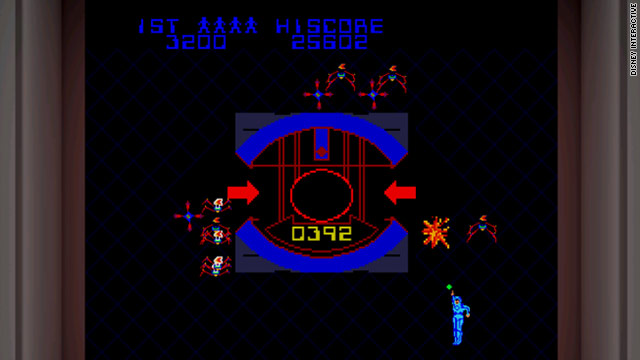
Released in 1982, the gaming classic, pitting human against computer in a virtual-world struggle, was the first major arcade game to have a big-screen movie tie-in.
That groundbreaking one-two punch, combined with "Tron's" gameplay wrinkles, which helped inspire other games for years to come, has kept "Tron" in the hearts of old-school gamers and longtime computer geeks for nearly three decades.
With "Tron: Legacy," hitting theaters on Friday and tie-in game "Tron: Evolution" in stores now, those fans have been reflecting on the 1982 game that started it all.
"'Tron' was this odd validation that, the computer stuff, that there was more to it," said Ricardo Torres, editor-in-chief of video-game news site Gamespot. "When I first started getting exposed to computers, it was kind of boring. ... 'Tron' sort of validated my belief, as a kid, that there was something cool about computers that we just weren't getting (yet)."
Manufactured by Bally Midway, "Tron" was designed in conjunction with the production of the 1982 Jeff Bridges movie about a hacker who is transported into a computer and forced to compete in virtual gladiator-like games.
The legacy of "Tron," the movie
(The "E.T.: The Extra-Terrestrial" game was also released for the Atari 2600 in 1982. But there was no arcade version, and development didn't begin until after the wildly popular Steven Spielberg film was released. It also is considered one of the worst video games ever, with Atari reportedly burying millions of unsold copies in a desert landfill.)
"Tron" may also have been the first popular arcade game to feature what would one day be called "mini-games," a staple of today's gaming perhaps most fully realized in the party games for the Nintendo Wii.
While Pac-man always ate dots and Space Invaders behaved mostly the same stage after stage, "Tron" offered four different games based on parts of the movie.
There are the light cycles (arguably "Tron's" most iconic images), battle tanks, a fight with "grid bugs" to get into the movie's Input/Output tower and a game mimicking the movie's final fight at the "Master Control Tower."
Play an online version of the classic "Tron" at Disney's site.
These challenges were an immediate hit with gamers. "Tron" was named Coin-Operated Game of the Year for 1982 by Electronic Games magazine.
A sequel, "Discs of Tron," was released in 1983 and featured the computerized, jai alai-style fight from the movie. It was supposed to be one of the original's mini-games, but couldn't be programmed in time.
John Vignocchi is the development director at Disney Interactive Studios who oversaw the creation of the "Tron: Evolution" games -- which include versions for Xbox 360, PlayStation 3, Windows LIVE and the Nintendo Wii, DS and PSP.
He also worked at Midway for 10 years, where he was mentored by George Gomez, a developer of the original "Tron" game.
"We're dealing with something that was not only revolutionary at that time from a movie-making perspective, but (something) that computer geeks and video-game nerds really embraced," Vignocchi said. "It was validating their passion, their love for gaming, and gaming was so young at the time."
"Tron: Evolution," which plays slightly differently on different gaming platforms, is set in the time between the original movie (and game) and "Tron: Legacy."
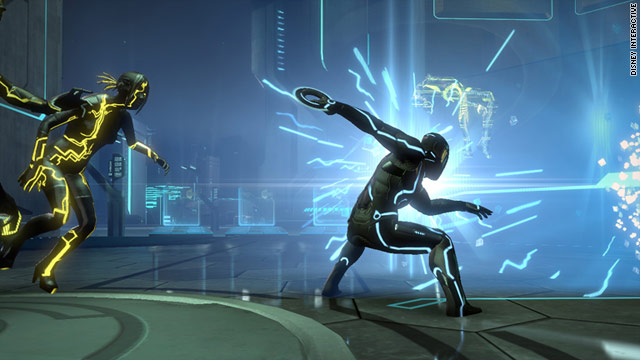
The player's character, Anon, is created by Flynn, the Jeff Bridges character from the original film, to help fight a virus infecting his virtual world. The game incorporates drastically updated versions of the original "Tron" games with new challenges.
The original movie and the game's style obviously helped the arcade version of "Tron's" popularity, which initially was greater than the movie's. But even the look of the arcade game's cabinet, which Gomez designed, was key, Vignocchi said.
It featured black lights, fluorescent lines and a glowing joystick for a controller.
"The environment of the arcade at that time -- it was a very dark, happening place with loud music," he said. "Something about that arcade game was mesmerizing and it really resonated with me."
Of course, video game technology in 1982 had its limitations, especially compared to the state-of-the art visuals from the movie.
"I remember being really jazzed about the movie, then going to check out the games and it was like, 'Awwww,' " Torres said. "It didn't quite catch the action and excitement that you were getting in the film, which was kind of the standard.
"These days, I think folks are a little bit luckier because you have moments where a movie game kind of captures something about the film. ... Back then, you had to use your imagination a whole lot."
But enduring fan love for the classic game actually had some impact on the design of the new one, said Vignocchi.
Game designers aimed to make the iconic light cycles handle more like real motorcycles. But when gamers play-tested the feature, they missed the sharp, 90-degree turns players could perform.
"Gamers were going, "I don't care -- I'm a fan of 'Tron.' Where are my 90-degree turns?' " he said.
It's not just nostalgia. Computing experts said the virtual world that many future hackers began dreaming of because of "Tron" continues to inspire creativity in gaming and beyond.
John West, a special assistant to the director of the U.S. Army Engineer Research and Development Center's information technology lab, said he took inspiration from an odd source -- the movie and game's evil Master Control.
"I'm not much of an evil genius these days, since respectable evil geniuses don't carry diaper bags and pink pacifiers," he said. "(But) the idea of control, and of creating a world over which you could have complete control, was a powerful concept for a geeky 13-year-old freshman in high school."
With the release of gaming tools like the Wii controller and Microsoft Kinect's hands-free game system, he said, the world is still taking small steps toward the immersive, digital world that "Tron" imagines -- one in which complete virtual reality can be experienced.
"'The Matrix,' 'Tron,' even 'Star Trek: TNG,' all have much more sophisticated interaction modalities than we have today," West said. "But as I think about it, we really are starting to see all the right technologies fall into place."

Yahoo targets Buzz, AltaVista, Delicious for death

NEW YORK (CNNMoney.com) -- Days after cutting its global workforce by 4%, Yahoo turned the axe on its product portfolio. Yahoo said Friday that it is killing Buzz, a two-year-old experiment in community news curation.
Buzz never took off, and its termination isn't much of a surprise. But deeper and more painful cuts are coming: According to a leaked screenshot of an internal webcast by Yahoo Chief Product Officer Blake Irving, the list of products slated for "sunset" also includes MyBlogLog, Yahoo Picks, AltaVista, Yahoo Bookmarks and Delicious.
Ex-Yahoo Eric Marcoullier -- who created MyBlogLog -- posted the screenshot, which has since been taken down, to his Twitter account. Irving shot back on Twitter: "Really dude? Can't wait to find out how you got the web cast. Whoever it is, gone!"
A Yahoo (YHOO, Fortune 500) spokeswoman confirmed by e-mail that the company is "cutting our investment in underperforming or off-strategy products" does "plan to shut down some products in the coming months such as Yahoo Buzz, our Traffic APIs, and others."
She declined to comment on the leaked screenshot or the fate of the other services, saying "we will communicate specific plans when appropriate."
But late Friday, Delicious posted on its blog: "No, we are not shutting down Delicious. While we have determined that there is not a strategic fit at Yahoo, we believe there is a ideal home for Delicious outside of the company where it can be resourced to the level where it can be competitive. We're in the process of exploring a variety of options and talking to companies right now."
More sites say goodbye to free content
Users of the targeted services weren't waiting around for official death notices. They took to Twitter early Friday to lash out at Yahoo. Fans of bookmarking site Delicious were especially irate.
"Dear #yahoo, you officially suck for shutting down Delicious, and I vow to never use you or your services again. Love, pissed-off-user," blasted one tweeter.
Launched in 2003, Delicious was acquired by Yahoo acquired in 2005 for an undisclosed sum. Though the bookmarking site is a cult favorite, data from Internet traffic tracker Compete shows a big dropoff in traffic: Around 525,000 unique users visited Delicious this November, versus almost 930,000 in the same month last year.

'Tron: Evolution' is a time bridge that sometimes sticks in a loop

(CNN) -- "Tron: Evolution" tries to bridge the time gap between the classic movie and the new version, but it sometimes lets gameplay and combat fall into a time loop that is exciting but repetitive.
The storyline is actually spread out over four console games that all have the same title. Disney Interactive Studios decided to develop slightly different versions for the Nintendo DS, Wii, Sony PSP and a version for the Xbox 360, PS3 and PC.
Each takes place in a portion of the time between "Tron" and "Tron: Legacy," transitioning from the DS to the Wii to the PSP to the next-generation consoles and the PC.
While there is no need to play all versions to get the whole story, it may be more age-appropriate for younger players to stick with the Wii games.
I was provided copies for the Xbox 360 and the Wii to get a feel for the differences. And there are big differences.
The Wii version felt a lot like the arcade game from 1982. Players set up an avatar that can compete in 16 different game types featuring light cycles, battle tanks and a jai-alai type game.
Read about the legacy of the classic "Tron" arcade game
There is no online play, but up to four people can compete on the same Wii. This version does not have a story mode, per se, but does allow players to improve their characters with upgrades for offense and defense.
The Xbox 360 version is where the story takes off.
You are Anon, a monitor program created by Kevin Flynn -- the human programmer who created "Tron's" electronic world -- to find out why there is strife between the "Basics" (regular programs) and "Isos" (programs that seem to have free will).
The world is beautifully rendered and changes as the game progresses. In the beginning, it is bright and electric, but as the story becomes dark, so do the surroundings.
While there are plenty of programs mulling about, the game offers very little interaction with them except for specific, game-related instances. It appears wide open, but in reality, the action occurs on a very linear path.
Disney officials said the game tells a unique story of how CLU, the electronic system administrator, begins his takeover of the electronic world.
Game developers at Propaganda Games worked closely with movie makers to design environments, characters and vehicles that would mirror what appears in "Tron: Legacy."
In a convergence move, there are scenes in the game that will appear as flashbacks in the movie. It won't exactly look the same, but will show a viewpoint that's different from the one that plays out on the console.
Since the game story occurs before the new movie's events, equipment in the game appears as beta versions of what will eventually show up on the big screen.
Why fans love the movie "Tron" almost three decades later
Characters from the game, like Quorra (a nonplayer character who helps Anon) and Abraxas (a computer virus bent on destroying the world), also transfer from console to movie screen.
There are seven chapters in the game that span three different cities and the surrounding areas. And here is where the game starts getting repetitive.
Action usually consists of entering a room, battling some enemies, then moving to the next room via a series of leaps, climbs and slingshot maneuvers that resemble moves from "Assassin's Creed."
This room-jumping-room, room-jumping-room routine is played out repeatedly in the game.
Anon uses his disc to battle -- at a cost to his energy -- and the weapon can be upgraded at various disc stations throughout the world.
Four different types of combat powers (heavy, stasis, bomb and corruption) are at his disposal, as well as upgrades to energy, life and defenses.
The disc can be thrown toward enemies for a variety of effects that are made more powerful if done while leaping around the room. The disc also can be used as a melee weapon to strike enemies directly or hit the ground indirectly to create an area effect.
There are bright locations on the wall to get health and energy nodes to gain power for disc moves. Players will find themselves running from wall to node to battle and back again as they try to stay alive while fighting enemies.
It is fun to run up the wall, gain some health, flip off and fire a bomb toward a group of rogue programs.
However, the fun diminishes when battling more powerful bosses because it is a constant repetition of hit, run for energy, get hit, run for health.
There are some breaks in the run, jump and climb movements from area to area. Light cycles can be used to get from one place to another, but it isn't a race in the truest sense.
Players must avoid broken roads and obstacles, but there isn't the "running into the solid light trail" feature that was made famous in the arcade game and first movie.
There are also moments to use the classic game's battle tanks to move around. This is more fun, because you get to battle other tanks and forces while trying to get to the next building.
The game does have some role-playing elements. You will interact with nonplayer characters and can level up. In a nice twist, progress made in the single-player game carries over to the online, multiplayer action, and vice versa.
But combat there isn't restricted to opponents of similar strength, so it can, and does, sometimes set up battles between a level-20 player and a level-1 player.
When you're matched up against a similarly powered opponent, the fighting is pretty awesome with light cycles, discs and tanks.
Up to 10 people can compete on one of four maps in Deathmatch, Capture the Flag and King of the Hill missions. Leveling up here also transfers back to single-player action.
Overall, the game starts out exciting and fast-paced, and then slowly slides into sameness. The action still remains quick and almost frantic at points, but too much repetition begins to drain away the excitement.
It will be interesting to see how the story in the game transitions into the story in the movie. The game felt like it had a lot of potential, but it ran out of things to do, so developers kept presenting the exciting stuff over and over.
It isn't a bad game, but a good game that could have been great.
"Tron: Evolution" has different ratings for the different versions. It is rated E 10+ for the DS, PSP and Wii. It is rated T (fantasy violence, mild suggestive themes) for the Xbox 360, PlayStation 3 and PC versions. Only the Wii and Xbox 360 versions were reviewed for this article.

5 Web titans that withered under Yahoo

(CNN) -- For King Midas, as the Greek legend goes, everything he touches turns to gold. Yahoo's stroke is decidedly less effective.
The Sunnyvale, California, internet giant has acquired more than six-dozen technology companies in its 15 years. Many of those once promising rockets fizzled under Yahoo's supervision.
Yahoo plans to shutter several services, including Delicious, which was at one time the dominant social bookmarking site, according to an internal memo that leaked on Thursday. Upcoming.org, a promising start-up Yahoo bought that chronicles events in major cities, will be collapsed into other products, the memo said.
Yahoo may try to sell Delicious, formerly known as Del.icio.us, if it finds an interested buyer. Or it may spin off the group, suggests a company statement. And Yahoo recently expanded its blog network, showing an emphasis on news and original content.
A Yahoo spokeswoman notes that the company continues to focus investments on mobile, local and communication services. That doesn't bode well for the various start-ups Yahoo has acquired over the years that don't fit into those categories.
That's not to say that every purchase has been dollars down the drain. Acquisitions have morphed into some of Yahoo's most successful properties.
The 1997 purchase of Four11, which made a Web e-mail client called RocketMail, became the top U.S. e-mail site in Yahoo Mail. Less than a year later, Yahoo bought Sportasy, which propelled it as a leader in fantasy sports.
But in many other instances, Yahoo's touch turns new allies into stone.
GeoCities
At the turn of the century, GeoCities seemed an unstoppable force on the Web. The service, which allowed anyone to create their own free website, housed a sizable portion of the internet's contents at the time.
GeoCities made a promising debut on the stock market in 1998, and a year later, Yahoo paid about $3 billion for the company.
"The Yahoo sale was sort of bittersweet -- obviously, financially, it was great," said GeoCities co-founder John Rezner last year. "Nothing ever happened. GeoCities stagnated from day one."
In perhaps the most spectacular folly for Yahoo, the company closed the service about a year ago.
"Yahoo never knew the value of GeoCities," Rezner said.
Broadcast.com
The audio-streaming company that made Mark Cuban a billionaire turned out not to be a sound investment for Yahoo.
Broadcast.com seemed like a promising company, certainly to investors who poured money into it during the initial public offering, and for Yahoo, which spent $5.7 billion to acquire it.
Broadcast.com had little groundbreaking technology to defend its vulnerable market position, and Yahoo broke it into separate divisions. The current iteration of the online radio service, now called Yahoo Music, bears almost no resemblance to Cuban's cash cow.
Musicmatch Jukebox
Yahoo has made a few purchases of music companies that didn't quite pan out. LAUNCH Media and Webjay were fruits of Yahoo's attempts to muscle into digital music retailing.
But at $160 million, Musicmatch Jukebox was an expensive company that never quite found its footing under Yahoo. Its problems were compounded by the explosion of Apple's iTunes.
For a while, Musicmatch was the anointed software for Windows users who owned iPods. But Apple eventually released its competing program for Windows.
After taking on the name Yahoo Music Jukebox, the software was eventually scrapped in favor of a partnership with music subscription service Rhapsody.
Zimbra
Perhaps in a fit of Microsoft or Google envy, Yahoo bought Zimbra, an enterprise software developer, for $350 million. In January, Yahoo sold the division to VMware for a price "well below" what Yahoo initially paid, according to a report in AllThingsDigital.
HotJobs.com
In another case of depreciated value, Yahoo bought job-recruiting giant HotJobs for $436 million in 2002. At the time, Monster was still seen as the dominant force.
In February, Yahoo unloaded HotJobs to Monster for nearly half what Yahoo originally paid.
Which is next?
This tainted track record leaves many industry observers whispering about Delicious facing a similar fate.
It's also prompting questions from bloggers and insiders about the future of photo-sharing site Flickr, another Yahoo property.
As far as online image sharing goes, Facebook quickly zoomed past Flickr and never looked back. Yahoo CEO Carol Bartz says Facebook is Yahoo's "greatest competitor."

Friday, December 17, 2010

Now You Can Read Instapaper on Kobo Apps

E-reading service Kobo announced Friday that it is updating its iPhone and iPad apps to include Instapaper integration. Customers will be able to read articles they’ve clipped from the web within the same e-reading app that they use to read their e-books and other digital content.
Users can link their Instapaper accounts to Kobo by entering a user name and password. A new book with an Instapaper cover appears on their virtual bookshelves, and its contents are automatically updated as they add web content to their Instapaper accounts. For now, features like bookmarks, highlights and notes are disabled for Instapaper articles, but other than that the reading experience is similar to an e-book.
The Instapaper integration is the second major update Kobo has made to its apps [iTunes link] this month. Last week, the company added a social reading component to its iPad app, called Reading Life, that allows users to check in to books, win badges and share passages with friends via Facebook.
Plans to add Reading Life to Kobo apps on other platforms are in the works, and this latest update complements the social reading feature nicely. One component of Reading Life, for instance, is an individualized reading profile that includes stats like hours read, books completed and percentage of library completed. Adding Instapaper to the iPad app allows Kobo to include information about the users’ web content in those stats for a more complete profile of their “reading life.”

“FarmVille for Dummies” Is Real and Available for Pre-Order

We have a new frontrunner for the most redundant book title of 2010 award: Wiley’s FarmVille for Dummies, available for pre-order on Amazon now.
On sale for $13.14, the book won’t be in print until February 15 of next year. But if you can’t wait until then to know what’s inside, here’s how the “only how-to, full-color book available on the game sensation FarmVille” is described on Amazon:
“… Yet, there has been no beginner guide that offers an introduction to newcomers and updates to experienced players … UNTIL NOW! (emphasis ours).
FarmVille For Dummies is aimed at getting novices acquainted with FarmVille rules and regulations, while more savvy players can sharpen their skills and find out how to stay up to date on the latest FarmVille features.
You’ll discover how to download the app, create a farmer avatar, and establish your first farm. Then you’ll progress to finding neighbors, purchasing farm cash and coins, shopping at the market, and more.”
Unlike other amusing jabs (that proved to be hoaxes or parodies) at what social media and gaming elitists might feel is a fairly sophomoric game, what makes FarmVille for Dummies so amusing is that it is, indeed, real. And truth be told, there’s probably a market for it; the game currently boasts some 55 million active users on Facebook (), and spinoff CityVille is already parent company Zynga’s fastest growing franchise to date.

A peek at next year's Macs

Today's iMac and MacBook Pro. Photos: Apple Inc.

Reports from Apple's Asian suppliers hint at lighter, more affordable machines
An item in Thursday's DigiTimes offers an early glimpse at Apple's (AAPL) plans for its flagship computer line in 2011. The details -- based on reports from unnamed "upstream component makers" -- are sparse:
  • At least four new MacBook Pro models with a "slight" change in chassis design
  • A new iMac with a different screen size and a presumably lower price point "for the mainstream market"
  • Software upgrades to the new OS X Lion operating system that Steve Jobs introduced at Apple's  October "Back to the Mac" event
  • DigiTimes didn't specify what chips might run the new machines, but CNET reported last week that Apple is planning to adopt Intel's (INTC) "Sandy Bridge" architecture, due to be introduced at January's CES, that puts graphics and the main processor on the same chip.
According to DigiTimes, the new machines are scheduled to ship in the first half of 2011, which would be roughly in line with Apple's usual 12-month upgrade cycle. The MacBook Pro was last refreshed on April 13, 2010; the 27-inch iMac was introduced on July 27.
Although overshadowed lately by the iPhone and iPad, the Mac still accounts for nearly 27% of Apple's $65 billion annual revenue. The company's desktop line enjoyed something of a resurgence in fiscal 2010, generating $6.2 billion on sales of 4.63 million units, up 45% year over year. Apple sold more than 9 million notebook computers in fiscal 2010, up 25% from 2009. According to DigiTimes, notebook shipments should grow 30% to 40% in 2011.